

Tiyani Hahlani
Centre News Hub
MASVINGO — Artificial intelligence (AI) is reshaping industries across the world, promising greater efficiency, faster decision-making and new opportunities for innovation.
In Zimbabwe, the technology is increasingly finding its way into newsrooms, businesses, and educational institutions.
Yet as the country takes its first significant steps into the AI era, an important question is emerging: will the benefits be shared by all, or will some communities be left behind?

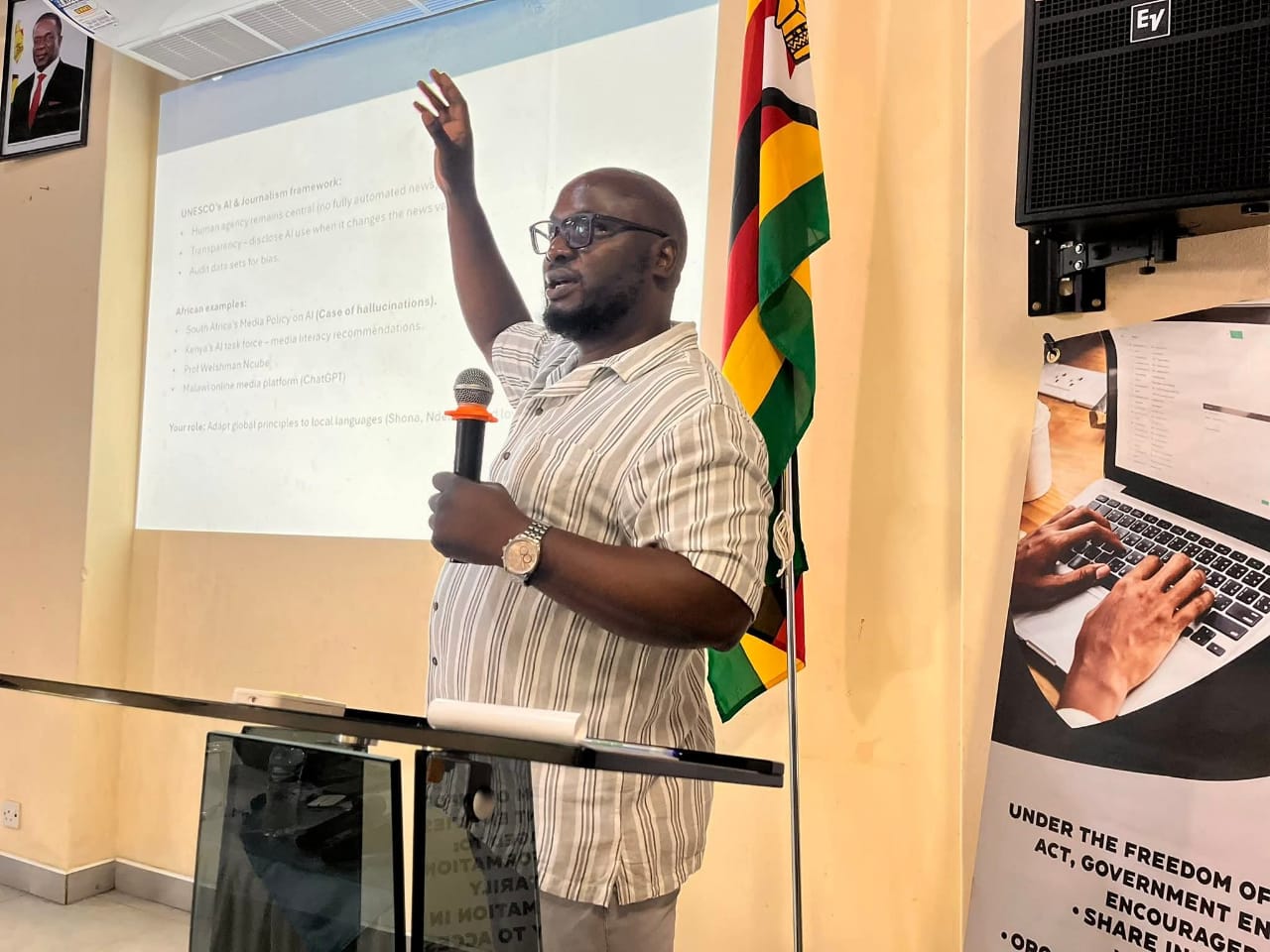
That question dominated discussions at a Zimbabwe Media Commission (ZMC) training workshop held in Masvingo on May 29, where journalists and media practitioners gathered to explore the opportunities and challenges presented by artificial intelligence.
For the ZMC, the workshop was not only about introducing journalists to new technologies but also about ensuring that AI is adopted responsibly and ethically.
Speaking on the sidelines of the training, ZMC Director for Media Development and Governance, Nyaradzo Makombe Hazangwi, said the commission was committed to helping journalists harness AI while maintaining professional standards.
“As ZMC, we are here in Masvingo engaging journalists and media practitioners as we train them in the use of Artificial Intelligence and also the ethical use of AI so that they do their work better, smarter and much more effectively, while also being able to verify information before they publish their work,” she said.
Across the globe, media organisations are increasingly using AI-powered tools to transcribe interviews, analyse data, generate story ideas and improve audience engagement.
For many newsrooms operating under tight financial and staffing constraints, the technology offers an opportunity to do more with fewer resources.
However, Hazangwi stressed that AI remains a tool rather than a replacement for human judgment.
“Having to use technology like AI comes with a responsibility, and that responsibility lies with the media practitioners themselves because AI cannot work on its own as it would need a human being to use it. This does not disturb the work of the journalist. AI helps media practitioners to do their work faster and smarter,” she said.
The rise of AI has also coincided with the growth of citizen journalism, where ordinary people use digital platforms to share news and information.
While this has expanded access to information, it has also raised concerns about misinformation and the misuse of AI-generated content.
“Lately, we have seen more citizen journalists adopting the use of AI, but as ZMC, we would recommend that people in our communities get news from qualified journalists because they have been trained on how to use these tools ethically,” she said.
Yet beyond concerns over ethics and misinformation, participants at the workshop warned of another challenge: the risk of a widening digital divide.