
News Editor
Center News Hub
Mwenezi East- A concerted push to improve water access and community infrastructure in Mwenezi East Constituency is delivering tangible benefits for residents across several Wards.
Wards 2, 5, 13, 14, 15, and 18 have witnessed great transformation of lives of villagers and schools courtesy of proper utilization of a Constituency development funds (CDF) by the local Member of Parliament (MP) and Deputy Minister of Foreign Affairs and International Trade, Sheila Chikomo.
She has improved access to water in the community by drilling boreholes around the constituency and learning infrastructure through the construction and renovations of classroom blocks and water access in schools.
Legislator Chikomo emphasized that the boreholes are more than sources of drinking water; she described them as “engines for local development.”
“I urge constituents, especially women and youth, to leverage the improved water access to pursue income-generating ventures such as gardening and fish farming, which can bolster household livelihoods,” she added.
Strategic investments under the Constituency Development Fund (CDF), aligned with the Presidential Rural Development Programme (PRDP), are transforming daily life for nearly 95,000 inhabitants in a drought-prone area, where water scarcity and underdeveloped services have long constrained development.
Historically, communities in Mwenezi East faced severe water shortages as traditional wells and older boreholes dried up.
The scarcity affected households, livestock, schools, and agricultural activities, with residents often traveling seven to eight kilometers to fetch water.
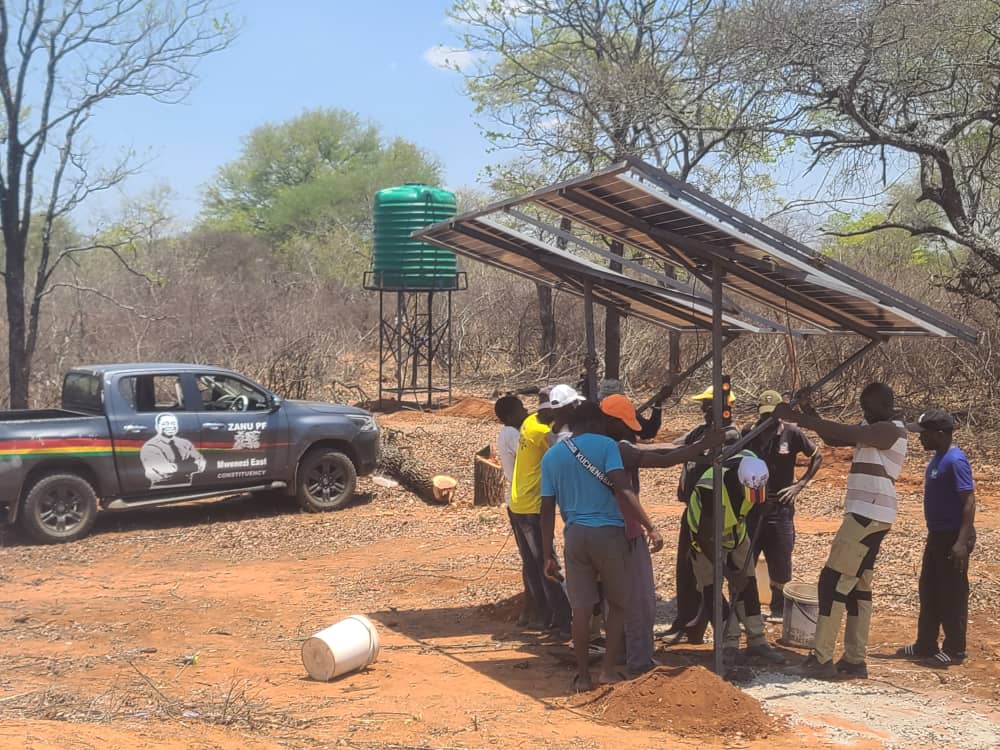
The new program has responded with seven solar-powered boreholes, each equipped with high voltage solar systems to ensure reliable, climate-resilient water supply.
The boreholes are located at Dip Mpapa (Ward 2), Chivumbulu Primary (Ward 13), Sosonye Primary (Ward 15), Mariot Village (Ward 18), Muzvagwa Village (Ward 14), Juneri Clinic Site (Ward 5), and Batanai Primary (Ward 2).
The first borehole, deployed at Sosonye Primary School, was commissioned on 31 October 2025, marking a milestone in the constituency’s drive to secure water for learning, farming, and household use.
The development initiative extends beyond water supply.
In addition to improving access to clean water, several school infrastructure upgrades are underway to create safer and more conducive learning environments.
Chemhara Primary School received roofing sheets, Chingwizi Primary School was provided with cement, Mangondi Primary School with galvanized iron sheets and cement, Marriott Primary School with cement and paint, and Mukume Primary School with paint.
These improvements are expected to enhance safety and functionality, supporting better hygiene, classroom capacity, and student performance across the region.
MP Chikomo also acknowledged the leadership of His Excellency, President Dr. Emmerson Dambudzo Mnangagwa, for prioritizing grassroots development through the CDF and for advancing the government’s “leaving no one and no place behind” mantra
Local leadership has also voiced strong support for the initiatives.
Councilor Timothy Magoche, of Ward 15, lauded MP Chikomo for prioritizing water security, stating, “We are really proud about this development which will ensure water security in Mwenezi East, I salute our Hon Member of Parliament for ensuring a swift approach by bringing water to the people.”
The project’s emphasis on devolution and participatory governance reflects a broader strategy to address local priorities through targeted, community-led investments.
The CDF and PRDP programs in Mwenezi East are part of nationwide efforts to expand rural water access and stimulate economic activity.
“Nationally, the PRDP has facilitated the drilling of more than 4,000 boreholes, with plans to establish 35,000 Village Business Units (VBUs) to foster agro-industrial activity, generate local employment, and strengthen rural economies. These initiatives align with Zimbabwe’s Vision 2030 and National Development Strategy 1 (NDS1), which prioritize universal access to clean water, improved sanitation, rural industrialization, and enhanced food security” said Mwenezi district information officer Rodney Kudzanai.
Residents have already reported notable improvements in daily life.
Community members say the reduced walking distances to water sources have eased time burdens on women and children, improved livestock survival, and opened new possibilities for home gardens and small-scale farming.
Elizabeth Mashingaidze, Chairperson of the Sosonye Primary School Development Committee (SDC), highlighted how prior water shortages disrupted school operations and learning, noting that the new borehole has transformed the school environment by enabling better hygiene and uninterrupted learning.
“The Mwenezi East initiative demonstrates how targeted investment, grounded in devolution and community participation, can yield lasting benefits for rural households and schools.
“By combining reliable water supply with upgraded educational infrastructure and the promotion of income-generating opportunities, the constituency is moving toward greater resilience against climate variability and more inclusive, sustainable development.” Mashingaidze said.
As the program progresses, officials and residents alike view Mwenezi East as a perfect model for leaving no one and no place behind through strategic, locally driven investments that deliver practical improvements to everyday life.