
News Editor
Center News Hub
Harare— In a bold move to close the digital gap in Zimbabwe’s classrooms, UNICEF handed over 815 laptops, 708 projectors, and 2,112 tablets to the Ministry of Primary and Secondary Education.
The milestone distribution aims to level the playing field in the education sector by equipping 113 disadvantaged schools across seven districts in Manicaland and Matabeleland South provinces with the tools they need to unlock the full potential of digital learning.
The handover, supported by the Global Partnership for Education (GPE), marks a significant step in expanding the integration of information and communication technologies (ICTs) in teaching and learning especially in underserved and hard-to-reach communities.
The initiative builds on prior investments that included a school solarisation programme funded by the Foreign, Commonwealth and Development Office (FCDO) and the installation of offline Learning Passport servers, ensuring reliable power and access to quality digital content even where connectivity is limited.
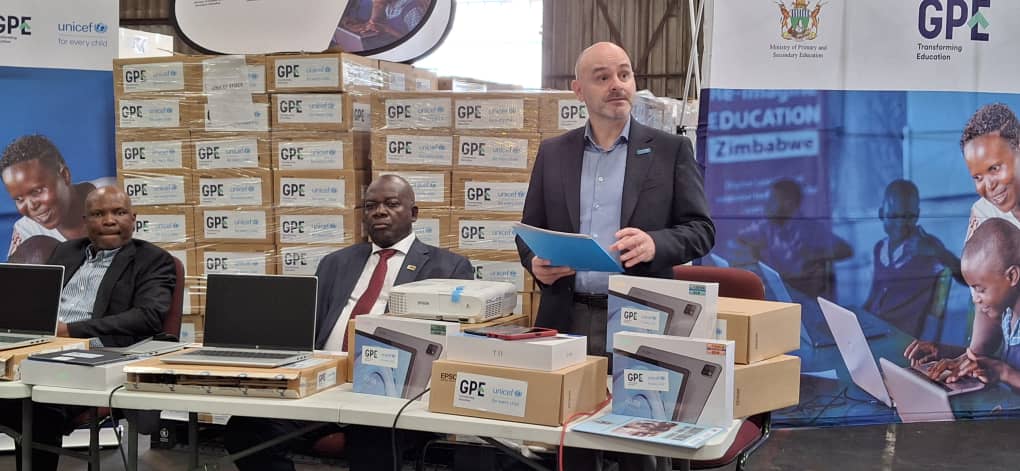
UNICEF and partners say these devices complete the digital learning ecosystem at school level, enabling classrooms to move from simply having access to technology to using it effectively for teaching and learning.
To ensure sustained impact, the rollout will be accompanied by structured teacher training that focuses on the integration of digital tools and practical classroom applications.
Two user manuals have also been developed: the first guides device management and basic maintenance, while the second equips teachers to apply blended learning strategies.
“This handover marks an important milestone in our collective effort to ensure that every child, regardless of where they live, has access to quality digital learning. By complementing earlier investments in solar power and offline digital platforms with ICT devices, we are enabling schools to move from access to effective use of technology in the classroom. This is about building resilient, inclusive and future-ready education systems that leave no learner behind,” said Fiachra McAsey, UNICEF Zimbabwe Representative Acting-In-Charge
Taungana Ndoro, Director of Communications and Advocacy in the Ministry of Primary and Secondary Education, welcomed the partnership.
“The Government of Zimbabwe warmly welcomes this strategic contribution from UNICEF and the Global Partnership for Education, which directly advances our national vision for a modern, inclusive, and equitable education system. This provision of essential ICT tools is not merely an allocation of devices, but a pivotal investment in empowering both our learners and educators in underserved communities.” said Ndoro.
He added that the handover represents a critical phase in the government’s deliberate journey to bridge the digital divide and ensure every child is equipped with the skills and resources to thrive in the 21st century.
He affirmed the commitment to sustainable and effective integration of technology into the curriculum, building on solar power and digital platforms to foster a generation of future-ready Zimbabweans.
Belay Addise, Regional Manager for East and Southern Africa at the Global Partnership for Education, highlighted the broader impact of equipment.
“Access to quality digital education is a critical part of equipping learners with future-ready skills. This handover marks an important moment in transforming Zimbabwe’s education system through the effective use of technology in classrooms. GPE is dedicated to building resilient and inclusive education systems that prepare all learners for the future.” Addise said.
As Zimbabwe’s classrooms embrace this new era of digital learning, educators, students, and communities alike look forward to a more connected, capable, and inclusive education system that can adapt to the needs of the 21st century.